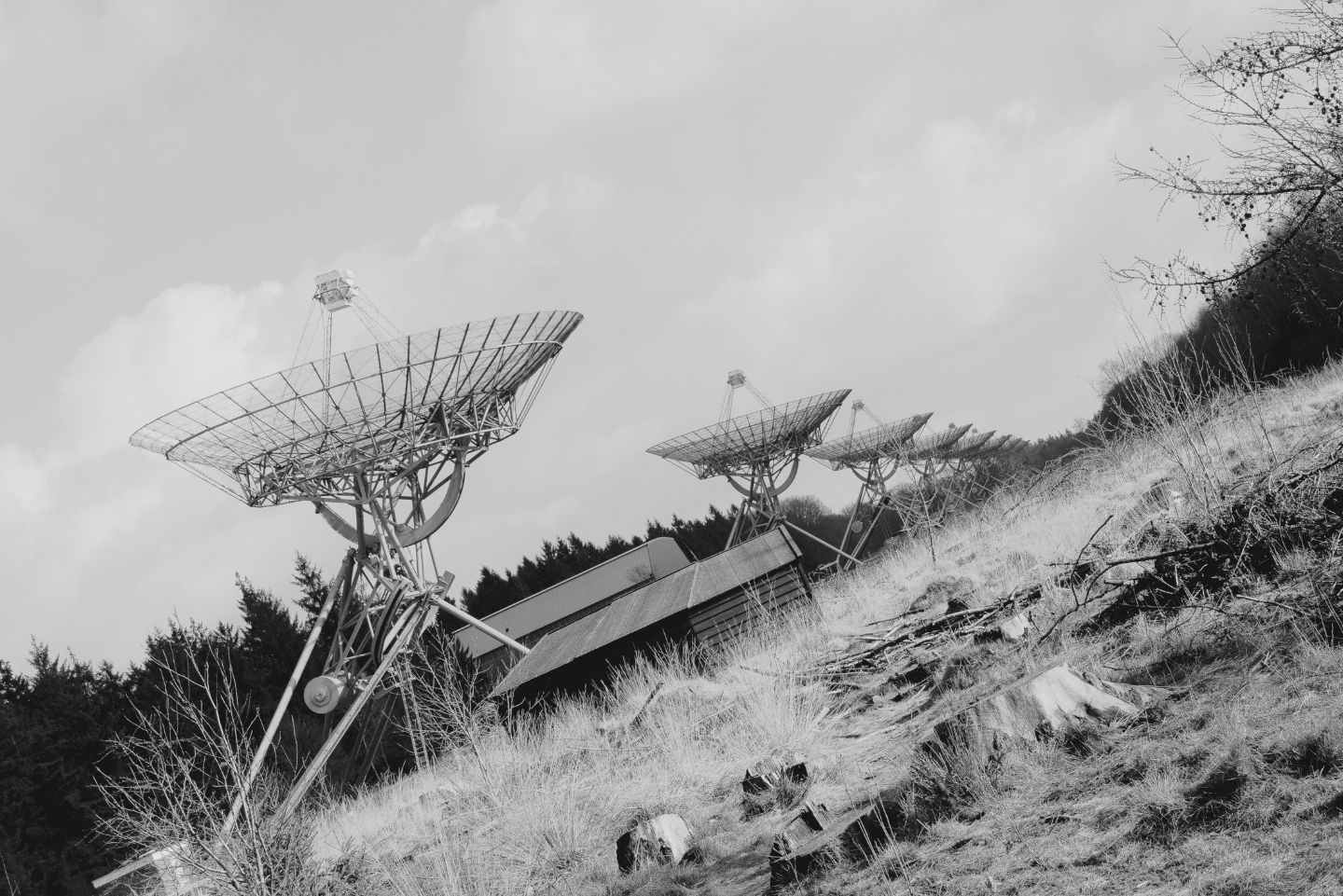
01 | THE BRIEF
At first glance, the third chapter of KPMG US’s Innovation Paradox series looked set to focus squarely on the rapidly expanding space economy: orbital infrastructure, lunar ambitions, commercial launch capability, satellite ecosystems, and the technologies shaping the next frontier of innovation.
But the intended audience was far broader than those immersed in the niche (albeit fast-growing) astroeconomy.
For more terrestrial executives, we faced an obvious first question… why on earth should they read this?
For leaders operating outside the aerospace sector, space innovation can quickly drift into abstraction: fascinating, futuristic, but disconnected from immediate commercial realities.
The brief? Use one industry's future to sharpen how we think about tomorrow for any sector facing complexity and rapid change.

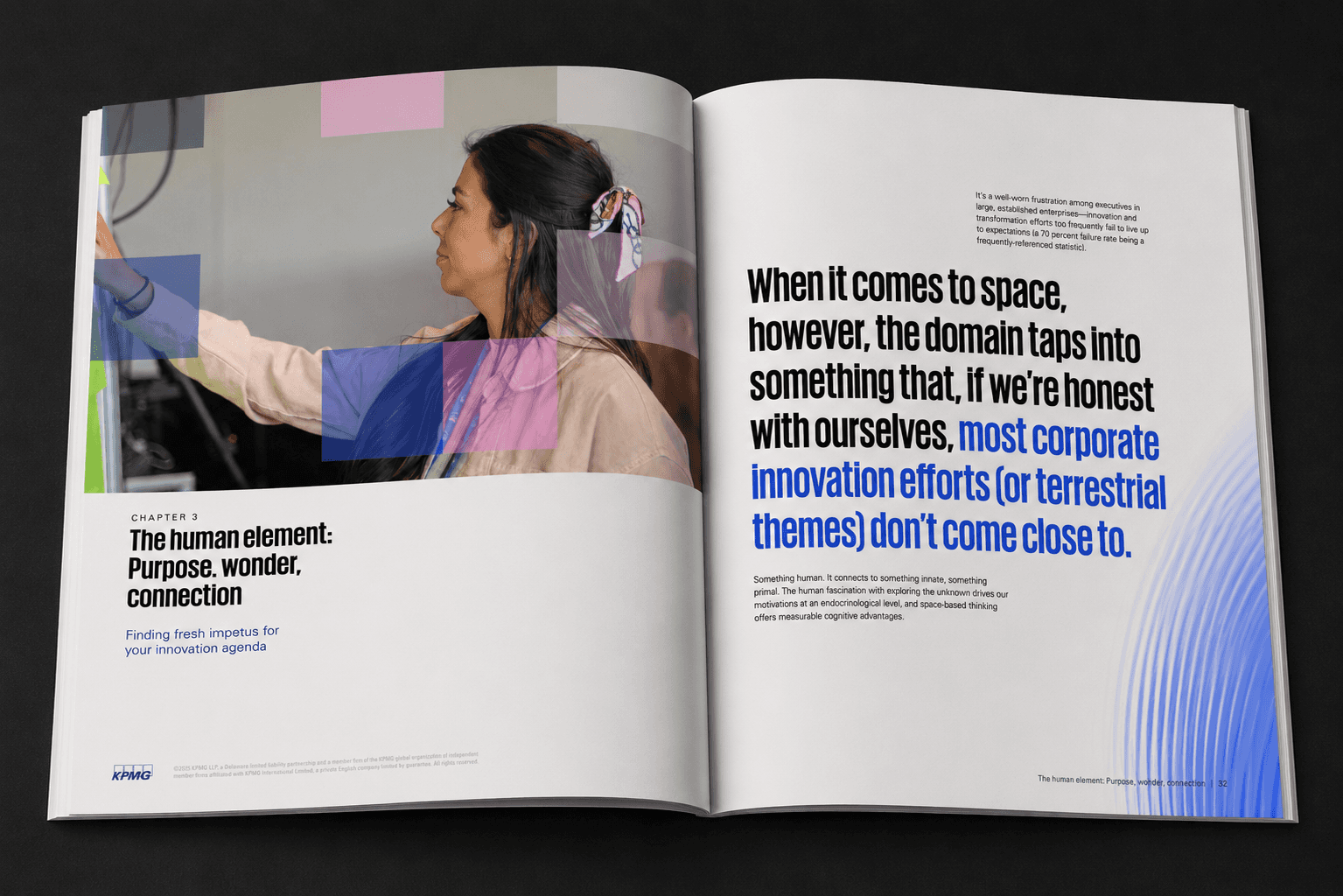
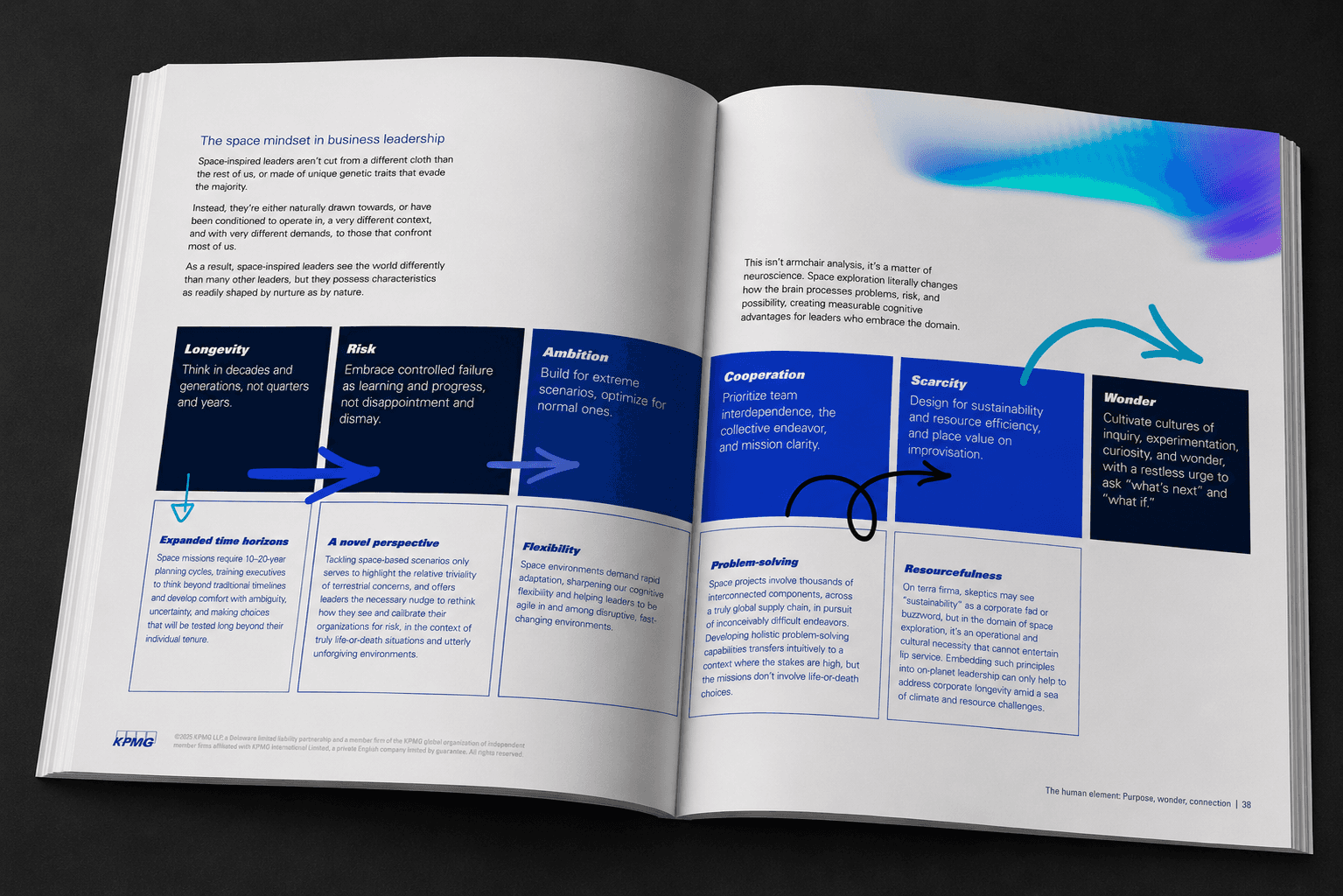
02 | THE FRAMING
Space as both subject and metaphor.
The best thinking begins with better questions, and this brief was no exception. The easy trap would have been to try and convince executives that they should care about launch capability, orbital infrastructure, or lunar ambitions.
Instead, we asked how we could demonstrate that the conditions shaping innovation at the edge might illuminate decisions much closer to home. This meant looking at space not simply as a market in its own right (the subject), but as an exaggeration of pressures already familiar across industries (the metaphor):
⇢ longer investment horizons;
⇢ compressed learning cycles;
⇢ interdisciplinary collaboration;
⇢ greater tolerance for ambiguity;
⇢ and new relationships between humans and technology.
We anchored the work around a single question: what becomes visible when organisations widen their innovation aperture?
Space is an uncertain and high-opportunity domain — progress only comes through long-term thinking, risk-obsession, and relentless experimentation.
These are precisely the capabilities boards and executive teams need to cultivate on earth.
03 | THE TRANSFER
From frontier to Boardroom.
The guiding principle for this project was transferability.
The first two publications in the Innovation Paradox series had carefully balanced making AI and behavioural science accessible and pertinent for leaders… this had to do the same, albeit with an arguably more challenging context.
Building the narrative drew on interviews and source material spanning the space economy, innovation practice, and adjacent disciplines that could explain how breakthrough thinking emerges, scales, and embeds.
Patterns were surfaced across domains, pressure-tested for Boardroom relevance, and distilled into a broader set of questions for leaders operating in entirely different contexts.
THE SPACE ECONOMY
EXPERT INTERVIEWS
TRANSFERABLE PATTERNS
EXECUTIVE IMPLICATIONS

04 | THE OUTPUTS
An invitation to think differently about innovation.
A comprehensive suite of practical questions and challenges for the C-suite, and for Boardroom officers… specifically tailored to their roles in strategy, risk, and governance.

If you’re working through something important, I’m always open to a conversation.
Usually around something complex, unresolved, or important enough to warrant thinking through properly.
thomas@thinkstuff.media
uk.linkedin.com/in/ThinkStuff
BASED IN CORNWALL, UK
Working with clients globally.
ThinkStuff
© Thomas Brown, 2026