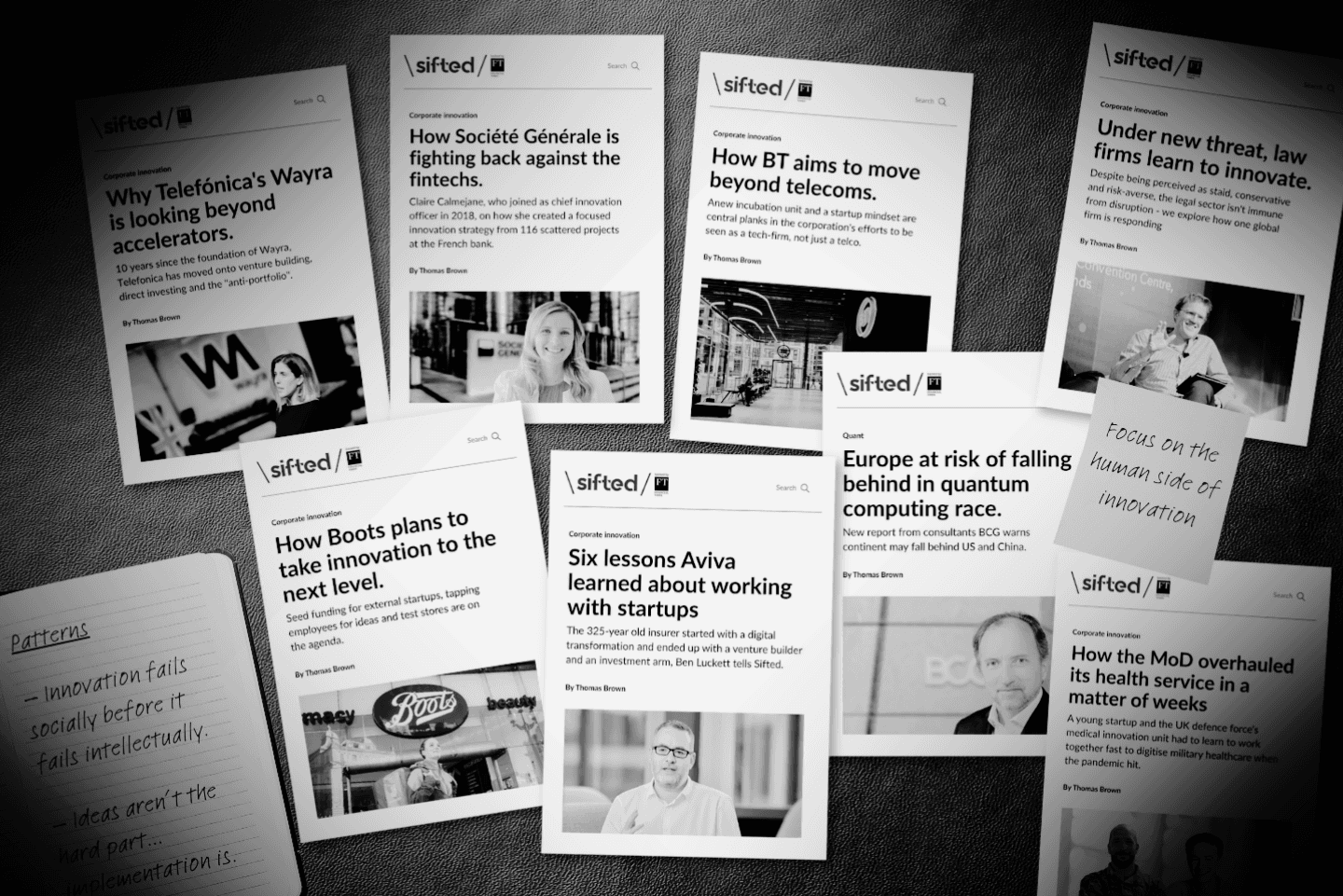
CASE STUDY | SIFTED
Helping leaders think more honestly about change.
An editorial series exploring innovation culture, institutional resistance, leadership tensions… and what it really takes to make transformation stick.
SCROLL TO READ ↓
01 | THE PARADOX
Corporate innovation rarely suffers from a shortage of ambition.
Large organisations launch incubators, create venture arms, redesign operating models, recruit entrepreneurial talent, and announce bold transformation agendas with impressive regularity.
The real question is why outcomes so often fail to match the ambition behind them.
Conversations about innovation often centre on visible decisions: the size of the investment fund, how teams are structured, who gets hired, or how risk is governed.
But the answer to that opening question felt unlikely to emerge through greater scrutiny of operating models or fund design.
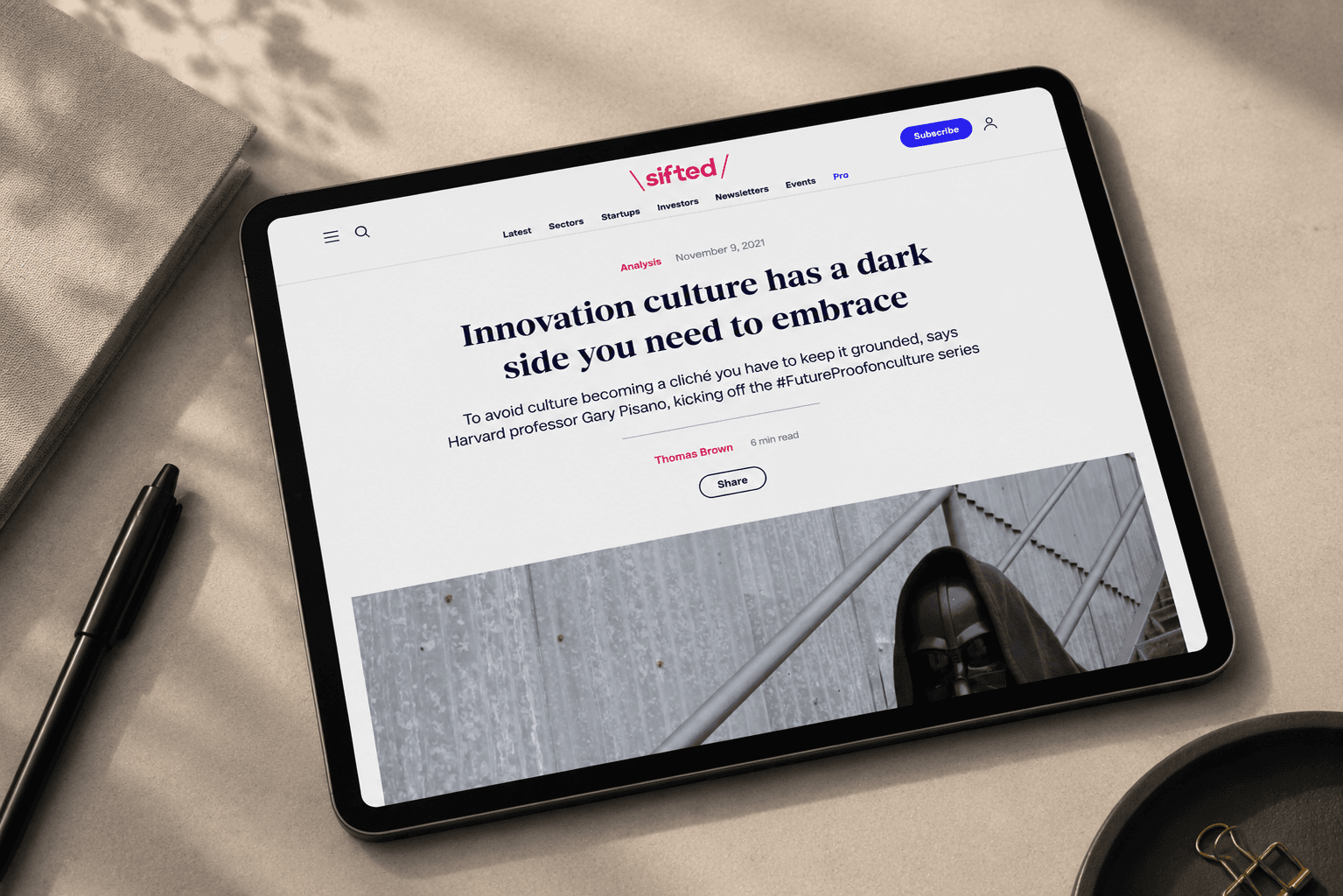
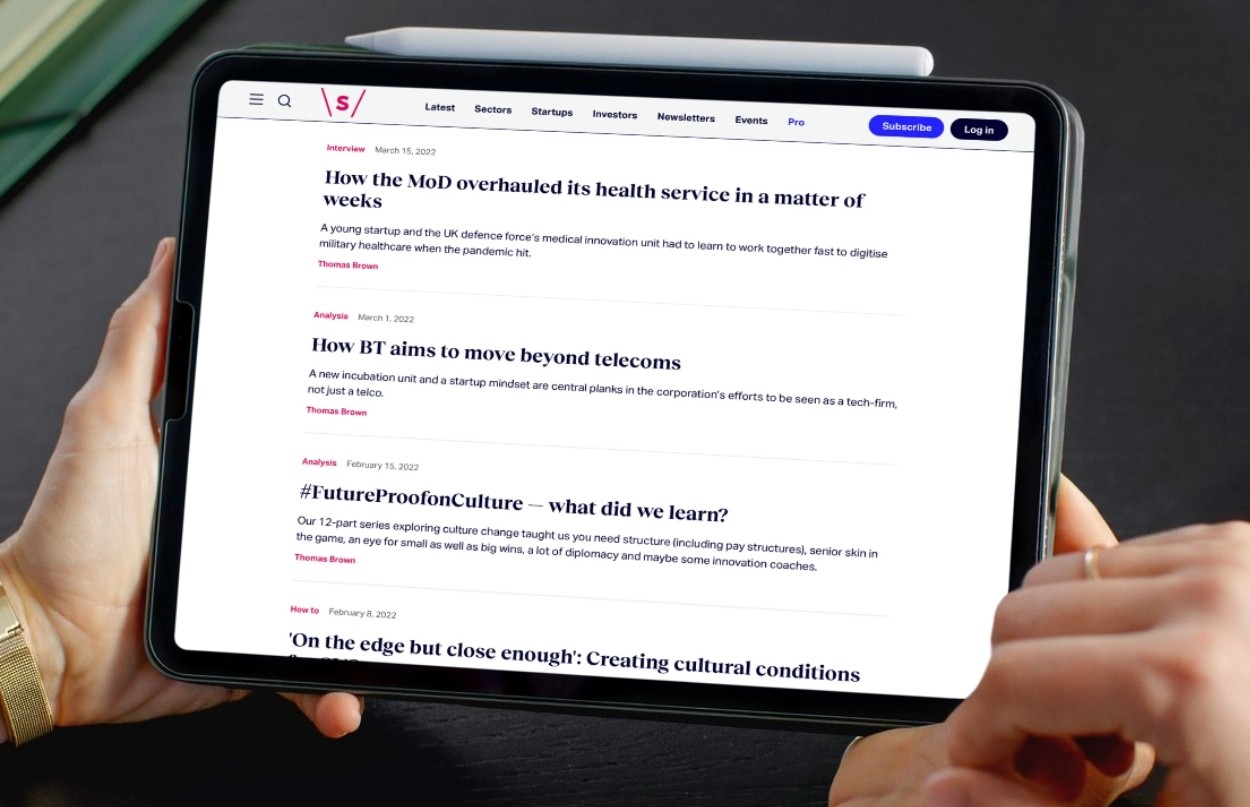
For Sifted — the Financial Times-backed media platform covering Europe’s startup and innovation ecosystem — I designed and led an editorial series built around a different hypothesis: that the reasons innovation succeeds or fails are often less technological than they first appear, and more human, cultural, and organisational in nature.


02 | THE FRAMING
Resisting easy explanations.
Corporate innovation often becomes trapped in familiar debates: should capability sit centrally or in the business? Build or acquire? Incubate internally or invest externally? Create dedicated structures or embed responsibility across the organisation?
These questions matter, but they rarely explain why innovation efforts so often fail to translate into meaningful, sustained change.
Instead, the series deliberately shifted attention away from invention itself and towards what sits behind common innovation challenges:
⇢ When incentives collide.
⇢ When governance slows momentum.
⇢ When leadership support fades once change becomes uncomfortable
⇢ When executive sponsorship and conviction resets every time leadership changes
⇢ When long-term innovation rhetoric collides meets short-term return expectations.
⇢ When organisational antibodies begin attacking the very change they were designed to enable.
The focus? Innovation as a condition, not an outcome… and the organisational behaviours required to sustain it once the excitement fades.
03 | THE SYNTHESIS
A broad church.
Rather than limiting the conversation to innovation leaders or corporate operators alone, the reporting brought together voices from across the innovation ecosystem — including founders, senior transformation leaders, academics, and nd operators tasked with bringing an innovation agenda to life.
And each group tended to approach the problem differently.
⇢ Founders often emphasised speed and permission.
⇢ Large organisations spoke more about governance, scale, and execution.
⇢ Researchers focused on incentives, behaviours, and the conditions under which new ideas survive.
⇢ Transformation leaders returned repeatedly to culture, sponsorship, and sustaining momentum.
⇢ Innovation practitioners spoke more about incentives, organisational friction, and the gap between declared ambition and day-to-day behaviour.
The aim? To find recurring patterns… the tensions, trade-offs, and organisational behaviours that appeared regardless of sector, structure, or operating model.
And that offered clues as to the conditions that allow change to survive inside complex institutions.

If you’re working through something important, I’m always open to a conversation.
Usually around something complex, unresolved, or important enough to warrant thinking through properly.
thomas@thinkstuff.media
uk.linkedin.com/in/ThinkStuff
BASED IN CORNWALL, UK
Working with clients globally.
ThinkStuff
© Thomas Brown, 2026